May 16th, 2013
[Department Chair], [Faculty Advisor], Distinguished Faculty at [the School of Art]; Senior & Visiting Critics; Thinkers, Makers and Lookers:
The invitation to reflect, and to review points of criticism raised at final reviews, benefits me.
Your concerted, serious, consideration of my work and extended studio practice is an enormous privilege – one which I do not take lightly, but appreciate deeply.
Thank you,
E. W. C. Nabrit
***
CONTENTS: This document contains: a comprehensive review of points of criticism; reflections on the discursive nature of the critique; images of the work shown; this brief introduction; with an abstract, following.
***
Section 1
INTRODUCTION: Evan Washington Clarke Nabrit, b. 1982, B.A. Cum Laude, Amherst College, 2006e MFA candidate, PennDesign, 2014, ICA Philadelphia Graduate Lecture Fellow. Background: knife painting (Hawthorne Method/Hudson River School). Currently: deskilled painting (neophyte), manipulated materials (salvaged & bought)
–
My primary strategy vis-a-vis the first year of grad school has been formal. I have been thinking methodically about how to develop a new and unique paint language; I began by first deskilling, and evacuating the work of meaning, i.e. figures, narrative and politics. In their stead, I have tried to privilege drawing. Only later (second semester) did I begin to reintroduce content. And now I feel somewhat confident that I can use this new language as a vehicle to execute certain of my art-wants – I now feel able to locate my interests with paint.
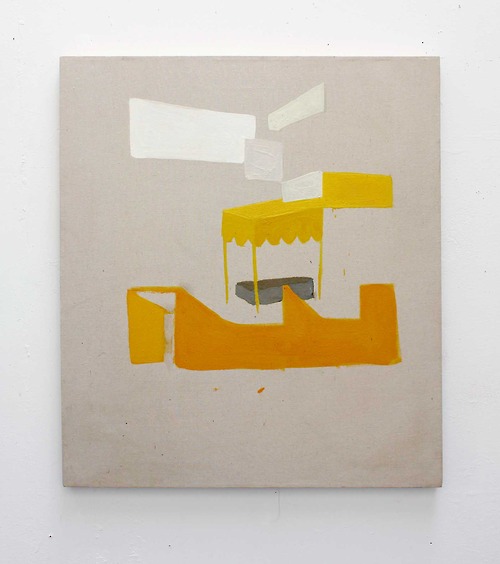
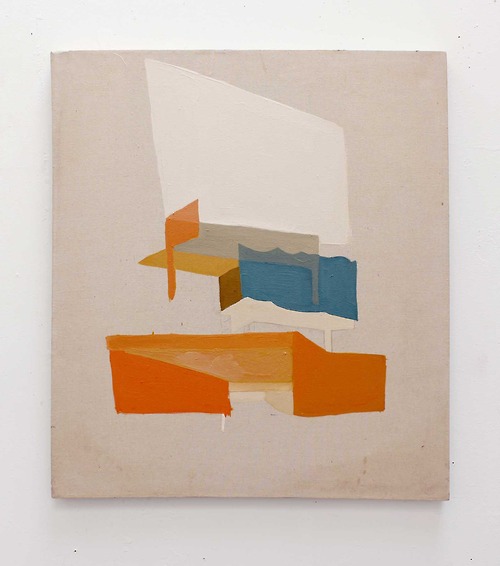
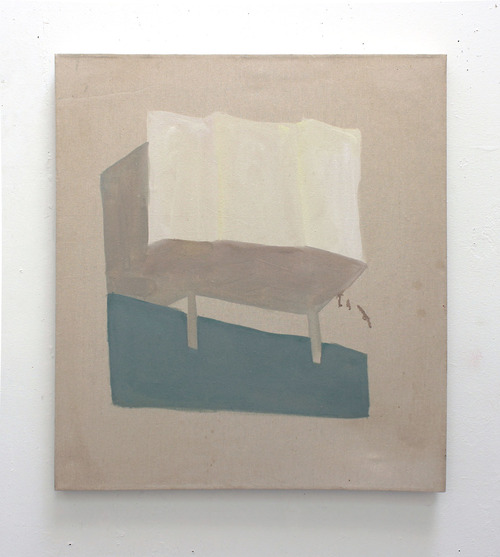
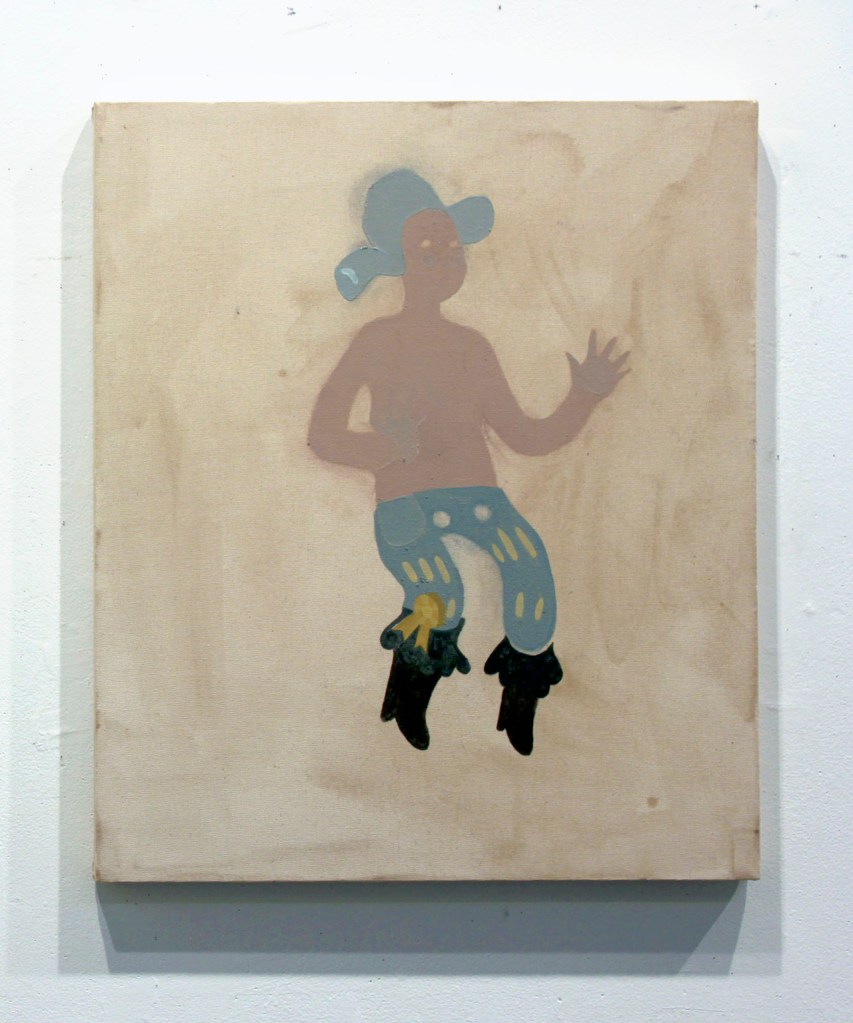
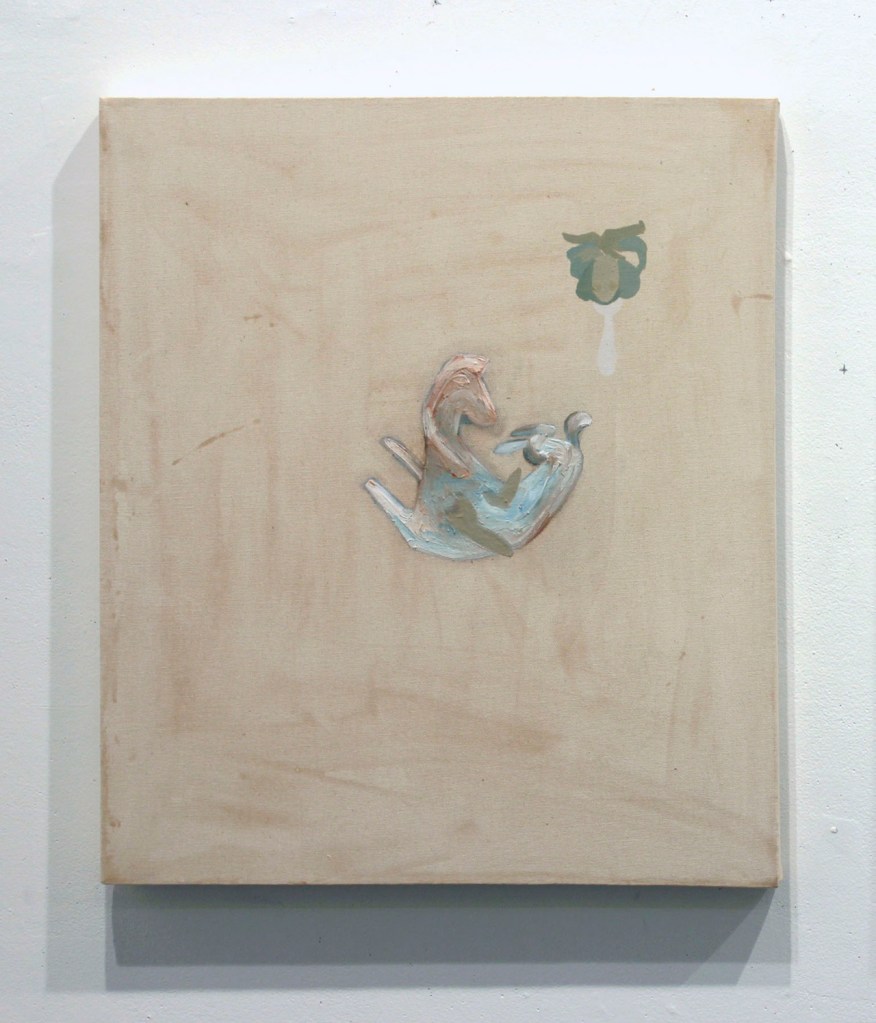
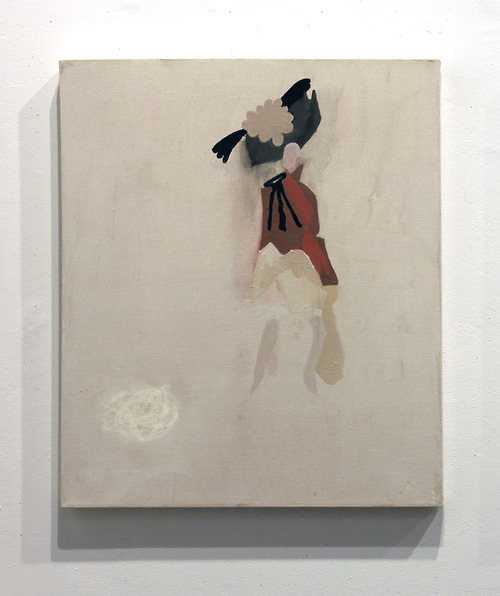
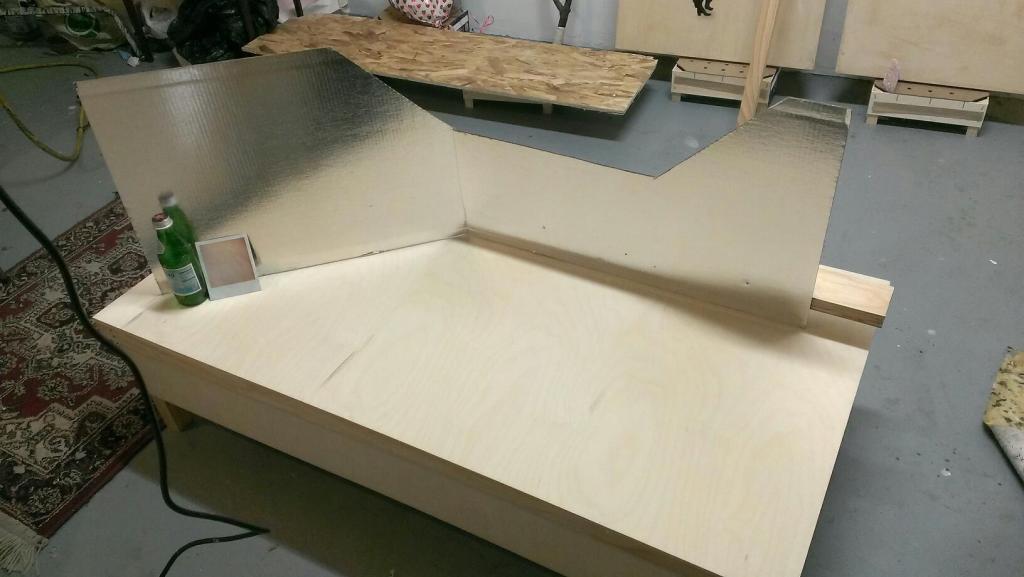
But farther art-wants require more divers means. So, along side painting, I have been experimenting extensively with object-making, and with more sculptural gestures, and “events” (to borrow Terrys language). This parallel practice happens intuitively, for the most part. And it helps me to figure out certain moves necessary to painting. I have been leaning on materials to process information, ideas and experiences. And I see the product functioning notationaly, like a sketch.
The most important thing uncovered during 8 months of sustained research and experimentation – the thing that I will no doubt continue to struggle with – is the triangular agreement between: a) The completed work, as an object in the world; b) The world, and how it encounters said object; And c) my delivery of the object into language.
Elements a) b) & c) are not separable, and likewise, are currently dysfunctional, in my (and others’) estimate. So in my fourth semester, I would like to bring the triangular agreement into some sort of alignment with my intentions as maker.
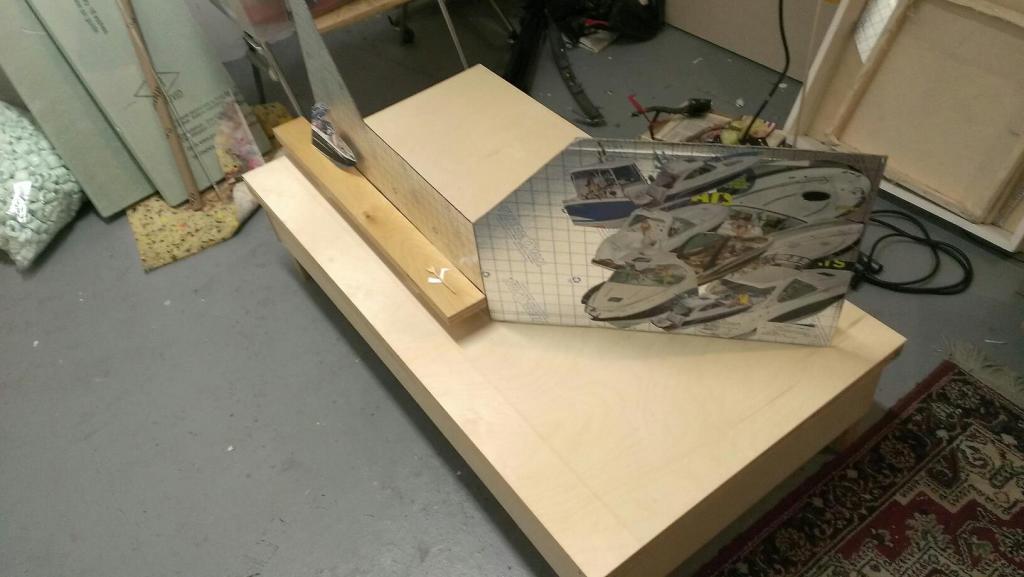
***
ABSTRACT
10:30 am, Sunday, April, 28th, 2013: [the School of Fine Art] conducts their third day of Final Reviews among graduating, and continuing MFA candidates. First-year student E. W. C. Nabrit participates with faculty, senior and visiting critics; the department Chair, his academic advisor and the extended university community, in a 30 minute, public critique of Nabrit ‘s total installation at [campus building] Lower Northeast.
The standard format of critique begins with a 5-minute introduction of the installation. Nabrit is asked to provide further description of his thinking around the work, after the threshold passes. Nabrit obliges a circuitous, strange (to the point of being problematic) discussion of stance, with extensive questioning; inclusive of, what is the artist’s knowledge base, and general trustworthiness – the last of which finds Nabrit somewhat baffled.
A majority of constructive criticism (re. the total installation) fails to maximize its potential impact on the trajectory of Nabrit’s studio practice. Due, in large part, to Nabrit’s own dogged insistence on premeditation – specifically, that the install does accommodate multiple, contradictory and opposite, “reads”. The faculty reads this as “deflection”.
The following document is generated to outline a means to address unresolved points of contention raised by the faculty, chair, academic advisor, visiting and senior critics at [the School of Fine Art]; and means to demonstrate that these points have been both heard, and thoughtfully considered, by Nabrit.
The document has been generated in response to a formal letter of request by [Department Chair] to Nabrit on April 30th, 2013.
***
Section 2
POINTS OF CRITICISM
(NB: Speaking critics are identified by initial. Non-Speaking critics are not identified. Individuated responses by the artist have been removed to increase the scope of this discussion. A comprehensive response is included in the section designated ‘reflections’)
Participating in the discussion:
TA = faculty
CB = senior critic
JM = faculty
JT= faculty
MB= senior critic
MF= faculty
MG = visiting critic
MRK = visiting critic
***
Transcription: Sunday, April, 28th, 2013
CB] What is, “the irony of boat culture”?
MG] This is from a photo? These are invented?
CB] Things share a certain look, one would think they were apart of the same environment. But you said that is not the case?
JT] Who is the Smurf for you in this mythology?
You are telling me the actual character; I’m asking whom – how is it changed in this context?
Is it a stand in for somebody in your life?
Are you this character, and the artwork is the gift disguised as a bomb? Are you relating to one of these mental characters?
–
CB] You explain what the paintings are, but for me, it is not evident. I would have a lot of trouble imagining what you said about the Smurf. Is that what you want? Are these points of departure of do you really want the work to communicate that?
The two things you said are opposite because on the one hand you said you are interested in deception, and in using a certain convention to turn it around, and in order for that to happen, you need to be very clear. What is the convention that you are using, and what is it referring to?
–
MRK] I would second that, and I want to bring up the video. That you sent us because there is this kind of baffling disconnect between what you say your intentions are; like you want the reader to have a high sense of agency; understanding things, multiple ways – but that video: what I was really thrown by, was the text.
And you seemed to be insisting, in a very charming manner, that we interpret it in a particular way, and walking us through what you were doing, and I was, I have to, I mean, I really wondered, if you were being serious. Like, signing off with ‘enjoy’. Maybe its because I was a waitress for so many years, but that’s what I said when I put all those meals on the table. And so it just I really, I think that what’s troubling and interesting at the same time is like – you – in all this.
And I can’t quite tell if you are being honest with yourself, about…I think you really want us to take a certain reading. And I think that came through in that text in that video.
Was it a parody, that letter?
Well it felt like, not to use too bombastic of a term, but it felt ‘manipulative’, and using charm to manipulate the viewer into a certain position, and an unwillingness to just let somebody think through it on their own terms.
I did feel like it was your own voice.
–
TA] There is a touch here that uh, borders on corniness. Throughout this work, for me, that I find…interesting. Um, and its got to do with the way things are presented. These supports for them, the canvas as a support for these images, the tables as supports for these…events, that’s curious to me, I don’t quite know how to put my finger on it, but uh, it borders on being…unbelievably corny. It’s kind of hard to describe. Maybe it’s in the manner of delivery, that they become corny, but I don’t say that (pejoratively) I think to a certain extent, it’s an extension of your personality
…Yeah, kind of. That becomes evident in the video, I feel. But I feel its best served, for me, in the paintings, as being the most mysterious…it seems to me like in these, there’s a ‘look’ that’s gone for, and this look has a surface that gets into this corniness. But the nature of the images themselves, are redemptive from that. And I get the sense that that is the most serious thing I’m seeing
–
MF] I was just thinking about the same thing, from a different point of view. I mean, I was thinking about these bases a lot. But not, I was thinking in terms of corniness. I was thinking in terms of your commitment. And what I see as your intellectual suppleness. And the sort of charm of the work. And for me this problematic notion that ‘things can be all things to all people – and that’s o.k.’
The greatest investment for me, as a maker, in this work, is in these bases. Which mimic a certain kind of museo quality presentation, they call for, they create, a certain kind of frame around the work which calls attention to it; creates a kind of credibility for these very delicate, brief, sort of, interventional gestures.
In a way which is totally out of sync with the gestures themselves. I’m a little bit more cautious about that…I love the stories behind these things. The idea of a landlocked lake full of boaters, who have their own sort of subculture, is great. You touch on it so tangentially, in such a kind of ‘whifting’ sort of way.
I don’t see it as being corny, I see it almost as, at best, a sort of sense-memory that animates you to put something together as a referent – but doesn’t commit you enough to, or doesn’t interest you enough, or, you’re not sure weather its interesting enough to: make that point, somehow.
I mean I could be a larger point, of how any sort of culture has its own sort of hilarious…rules, and hierarchies. That, from any point outside, make no sense. In such, ‘landlocked boat culture’ is no sillier than any other kind of subculture that sort of, justifies itself.
I just feel like, either take that point, make it your own and make us have to deal with it, or leave it alone and let the whole thing sort of become a kind of archive of these little moments, or something.
But somehow, the calculation, what a previous critic would call ‘ the governance of these pieces’ is a little bit out of character. I’m not quite sure, given the way you presented them…there’s a kind of weird ambivalence about weather we should take them as beautiful objects or weather we should take them as these thought experiments, that are really for all of us to invent on our own.
–
TA] Let me just qualify this point, when I talk about ‘corny’, I mean in the sense of delivery, of your delivery. The manner of delivery. Not that the work itself is corny, but their manner of delivery…kind of is.
–
JM] In the video, I want to follow up on this, you say, ‘I’m gonna propose this project, the project is happening in the background, its gonna work in this way, its gonna function in this way’, and it seems like – that’s the other necessary component in each of these pieces. And I think before I feel like I can talk about it, I feel like I need your outline.
And that’s really different than the work you applied with, which visually struck me first, and unfolded more as you started to talk about it. I remember you talking from your studio, with paintings behind, and the conversation…
So if your going to follow this summer, and continue to make pieces that work like the video works, then it seems like, maybe that’s part of the corny part about it, is that there’s a …you say “I’m about to do this, and its going mean this, and this is going to be a symbol, and the Smurf is not going to be a symbol…”, that kind of reminds me William Wegmans – the part that I don’t like and the part that I do, like about his dialogues, his conversations, its like, ‘here is something, and its doing this. And, check out if it does this’ but without you there…
Well its like: I can never forget now, that (gestures to table piece) having a relationship to the Hoover Dam. But I can’t access that without the fun, irony that you set up. So how can that be part of…the humor of it?
–
MB] I wanted…’corny’, you know, maybe I’d use the word, ‘ingratiating’… whether that’s an issue, and if it is, whether, you know, ‘corny’, ‘sweetness’, ‘ingratiating’, all that can work – depending on what you want to do with it… And then, but I think if that’s where you wanna go with it, ahem, I think you have to go a little bit further. With it.
But. In terms of a larger criticism, and this is where I’ll make my general statement – and it has something to do with, “the found object”. And a kind of groundedness, and the way in which, found…its so easy for people to just go and pick up things and use them, you know, they see them around, and include them into the work. And the history of “the found object” is a complicated one, and it had all sorts of philosophical and political justifications.
And I feel – all of that has been lost. And I wish more, when people would pick up things and bring them into the work…there was a much deeper sense of exactly what they were doing. About these objects, how they’ve been thought about before, how using found objects will relate to the culture because, you know they were some pretty deep motivations…
So that’s way of saying too, that I think there is something still…a bit facile, in the way things are pulled together, and the way you use them, and I really do think that the work needs to be more grounded.
–
MG] And to expand on that. A lot of the found objects- I think its a display problem with the objects, I don’t know that its the objects themselves. I’m not quite sure you’ve though them though, but if you would present them directly. All of your insecurities about their meaning and how they function in a bigger context, I can deal with. But they seem like a doge.
You’re tucking them, here and there. And the Smurf is way too high or way too low. And its not…
I want to contend with it. The same way I’m dealing with Pegasus – it’s an amazing painting. I mean in terms of symbolism, right? I mean, I think these things can be found, but in terms of painting, it’s within the history of symbolism, particularly in terms of image making.
But in that case in particular, unlike the other painting – you’re actually conjuring an object, right? The way you’re using paint. The way you almost conjure the Smurf, to some degree – it’s coming into this sort of physical bit.
But it has a platform and that platform is painting…. and the consistency of the little legs, on all the tables, including the found Clementine crates – that’s really interesting to me. Like, everything needs to be up on top of those things, to some degree.
Not necessarily that painting, because that’s not a good painting (gestures to red painting). But there is something about platforming, and how your platforming it, and right now your dodging the politic of the found object, or the political meaning, or whatever it is…Its like, I’m so not sure, I’m just going to tuck it.
I don’t care if you’re not sure – bring it up. Let me deal with that.
–
MB] I’m not talking about intention. I’m talking about history. And am talking about a larger relationship with history. And how that actually informs the work. I don’t question that you made these decisions for a particular reason. I believe that. But I think that the larger, there is a larger question of knowledge, a larger historical question that I don’t think is here. That I think really needs to be.
–
MG] Just in terms of the tucking of the bomb: that wasn’t lost on me. It just doesn’t have to have that double representation. For it to have that impact. I don’t know, it seems like a half-cooked, Contemporary Art Daily conceit of art installation.
–
CB] you have a very good relationship with language, and ideas. And that is a great tool. But it is also dangerous. It is a double-edged sword. In terms of dealing with the objects, and I think you have to be attentive to the object and ask the object to be as eloquent as you are.
–
TA] and by resorting to ‘pushing back’, by explaining away what you intended to do, doesn’t necessarily push back…its just more superficiality.
–
[inaudible]
MF] that’s important to remember
–
KL] I completely agree with Michael and Carlo’s’ point. I have this vantage point right here. I don’t think the word is earnestness, or ingratiation. I think its domesticity.
Everything becomes domestified (sic) and I’m standing up here, from this high vantage point, I see…it looks like an interior. It looks like, coffee table, end table…it just looks like its done for an apartment. The way its layed out.
And that tells me that the work comports itself too gently, its too nice, its too integrated into…you know, you want everything to satisfy the parameters of an architectural container or something. Without any dissonance. And maybe that’s what you mean by ingratiation, but from here it really looks like that.
Even that device over the light, it looks like your just making a lamp. Its not really about the content, or about transforming that light source – its a lamp. So there’s a kind of a muting that goes on in terms of what I think should be the raison d’etre of art, which is raising a kind of dissonance…it just looks like an interior set. When you stand here, you really see it.
For example, that piece, I love you, I think there is actually good potential there, you know, of course it belongs to a popular culture, this kind of residue of some moment of celebration or something; its been retrieved, its bound up, on this clementine box, which plays off “(Oh) My Darling Clementine”, right?
So there’s nice wit there – but because it’s placed onto once side, and because everything else looks so determined by interior decoration logic, it comes across like a toy. So it becomes denatured of its potential transgressive reading.
–
MRK] Can I? I think when you said, you hate for things to be “missed”. I think that’s the most true and honest thing that you’ve said so far.
And we can all identify with that, as makers, but there is a kind of death-struggle going on between your insistence on interpretation, and your facility at it – and your audiences’ freedom. Freedom to come to their own conclusions, freedom to misinterpret.
 EWCN | Visual Artist
You must be logged in to post a comment.